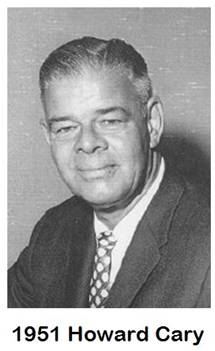
Howard Cary (03 May 1908 - 19 Dec 1991) was the founding president of the Optical Society of Southern California (OSSC) when the organization was established in 1951 and served until 1952. He was also co-founder and chairman of the board of Cary Instruments, originally the Applied Physics Corporation in Monrovia, California, and later served on the board of directors of Varian.
A Los Angeles native, Cary graduated from the California Institute of Technology in 1930 with a bachelor’s degree in engineering. Among his classmates was Roland C. Hawes, who later became OSSC president in 1956–57 and was named an OSSC Fellow. After college, Cary joined National Technical Laboratories in Pasadena, later known as Beckman Instruments, where he worked first as a development engineer and later as vice president for development. During his time there, he played an important role in the design of modern pH meters and two types of manual spectrophotometers.
In 1946, Cary joined George Downs and William C. Miller to found the Applied Physics Corporation. The company later became Cary Instruments and, in 1966, was renamed after becoming a subsidiary of Varian. Under Cary’s leadership, the company designed and developed the first commercial recording ultraviolet-visible spectrophotometer, the Cary Model 14. That instrument, in various forms, became widely used in industrial and institutional research laboratories around the world. Roland Hawes served as vice president of research and development from 1951 to 1972, and David Nelson later became president after Cary’s retirement.
Cary received major recognition for his work in applied optics and scientific instrumentation. The Optical Society of America awarded him the David Richardson Medal for outstanding achievements in applied optics, honoring his “painstakingly careful and very valuable contributions to the design and production of highly precise instrumentation in areas which range from spectroscopy to chemical, medical and nuclear research.” In 1958, he also received the Beckman Award in Chemical Instrumentation from the American Chemical Society, which recognizes outstanding achievements in the development of new methods for chemical process measurement and control.
As one of the co-founders of OSSC, Cary helped organize the society in 1951 as a local section of the Optical Society of America. He was one of five members of the organizing committee formed in June 1951, along with Eugene Thornburn, Felix Bednarz, Armin J. Hill, and Henry A. Knoll. On November 7, 1951, he was elected among the temporary officers and became the first president of OSSC, serving during 1951–1952. On March 25, 1952, the society’s articles of incorporation were approved by the California Secretary of State, and on July 17, 1952, OSSC was officially recognized as the eighth local section of the Optical Society of America.
Beyond OSSC, Cary served as president of the Instrumentation Society of America and was a member of the executive committee of the Western Spectroscopy Association. He also belonged to the American Physical Society, the American Chemical Society, the Institute of Radio Engineers, and the Society for Applied Spectroscopy.
Howard Cary died on December 19, 1991, at age 83, of pneumonia after a long illness. He was survived by his wife of 56 years, Barbara, and his sister, Mrs. James Reed.
The article is based on the
Howard Cary's OSSC Fellows Profile written by Tom Godfrey and has been edited here by Robert F. Cartland