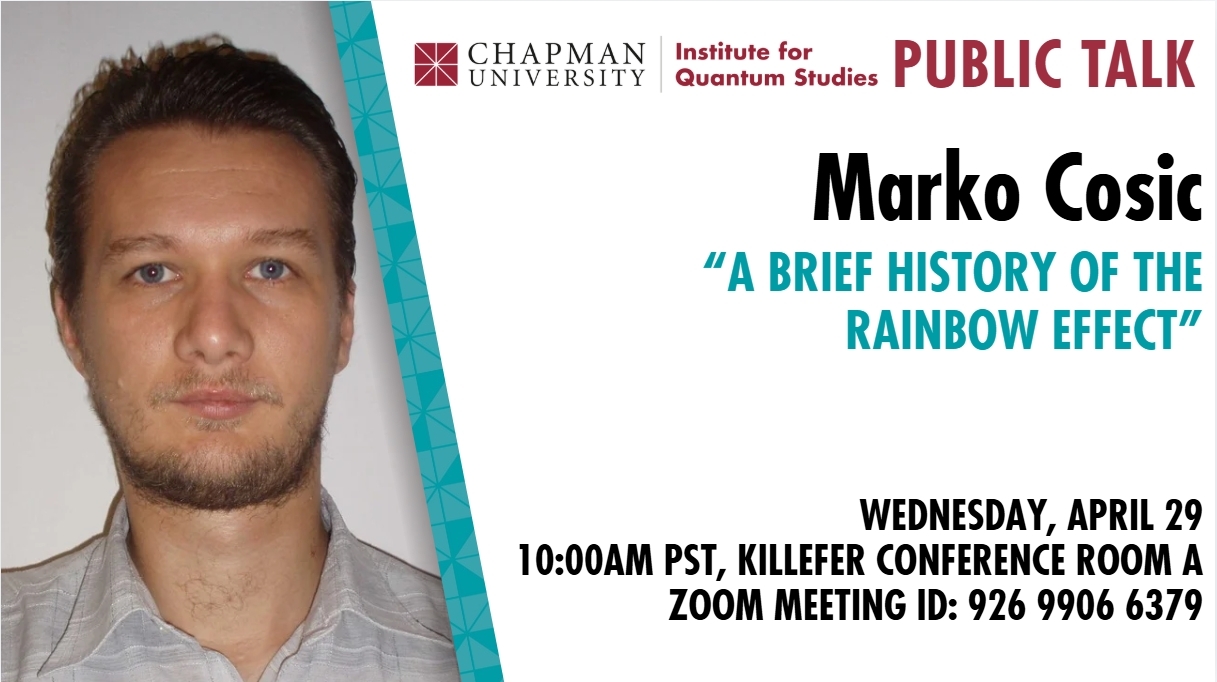
Chapman University - Institute for Quantum Studies - Wed. April 29th, 10am
(The OSSC is tracking the number of people registered through this website because the room can hold 100 total.)
Title: A Brief History of the Rainbow Effect - Marco Cosic
Abstract: In this lecture, we shall follow the historical development of human fascination with the rainbow effect, which has arguably occupied the human imagination since the dawn of time. Since the evolution of understanding of the rainbow effect spanned at least several thousand years, it is impossible to present a complete portrait in one lecture. Instead, we shall focus on the evolution of key ideas that led scientists to abandon supernatural explanations in favor of explanations based on rational principles, culminating in the current model of the rainbow effect, proposed by M. Nussenzveig and experimentally verified at the University of Rochester in the 1970s.
What is fascinating in this story is that progress is not continuous. For example, approaches based on geometrical optics, which were incrementally developed over a long period and successfully explained certain aspects of the rainbow effect, failed catastrophically to explain others. To progress further, it was necessary to completely abandon the concept of the corpuscular nature of light in favor of the wave theory of light, which provided an analytical solution to the problem.
As in any good story, this one has multiple plot twists. It has turned out that the analytical solution was practically useless, as it was given by an infinite sum of rapidly oscillating terms depending on multiple parameters, making the sum converge extremely slowly to the correct value. In the age before computers, even evaluating the exact solution was a very difficult, if not futile, endeavor.
Nowadays, we have efficient computer algorithms that enable accurate evaluation of the analytical solution. However, the drawback now is that the multiple-parameter physics of the rainbow effect is buried deep within the generated numbers, and there is no simple way to extract it. Again, the formulation of a qualitatively and quantitatively correct model required a new set of ideas, borrowed this time from concepts in quantum mechanics.
In the end, we shall briefly review other recent observations of the rainbow scattering effect and argue that we will probably never achieve a complete understanding of the rainbow effect as long as scientists, intrigued by its beauty and apparent simplicity, continue to ask new questions.